
With technical and funding support from Green Growth Africa in Partnership with the University of Waterloo – WISE, Canada and Bard Graduate Programs in Sustainability, USA, Ngora Girls Secondary School, hosted the Worldwide Teach-In on Climate and Justice Event, with 133 participants. The event lasted for two hours with four breakout sessions. The students had expectation as to how climate change could be mitigated has its impact has led to environmental hazards today like floods, famine, tornadoes, hurricanes, earthquakes, drought, landslides both in their communities and globally, thereby hampering the conditions of wholistic healthy living.

The first breakout session had the students ask and discuss questions regarding climate change and its impact. The students identified some practices carried out in their community that negatively affects their standard of living. Some of these practices includes deforestation which has occurred over time reducing vegetation cover that absorbs carbon dioxide for photosynthesis hence releasing carbon dioxide in the atmosphere, hence affecting their agricultural products, same with draining of swamps, reducing the water table and vegetation cover, burning of rubbish releasing carbon monoxide and carbon dioxide gases to the atmosphere, transport machines like vehicles that release carbon monoxide and carbon dioxide gases to the environment, among others.They have, suffered from hunger, poverty, low animal and food productivity.
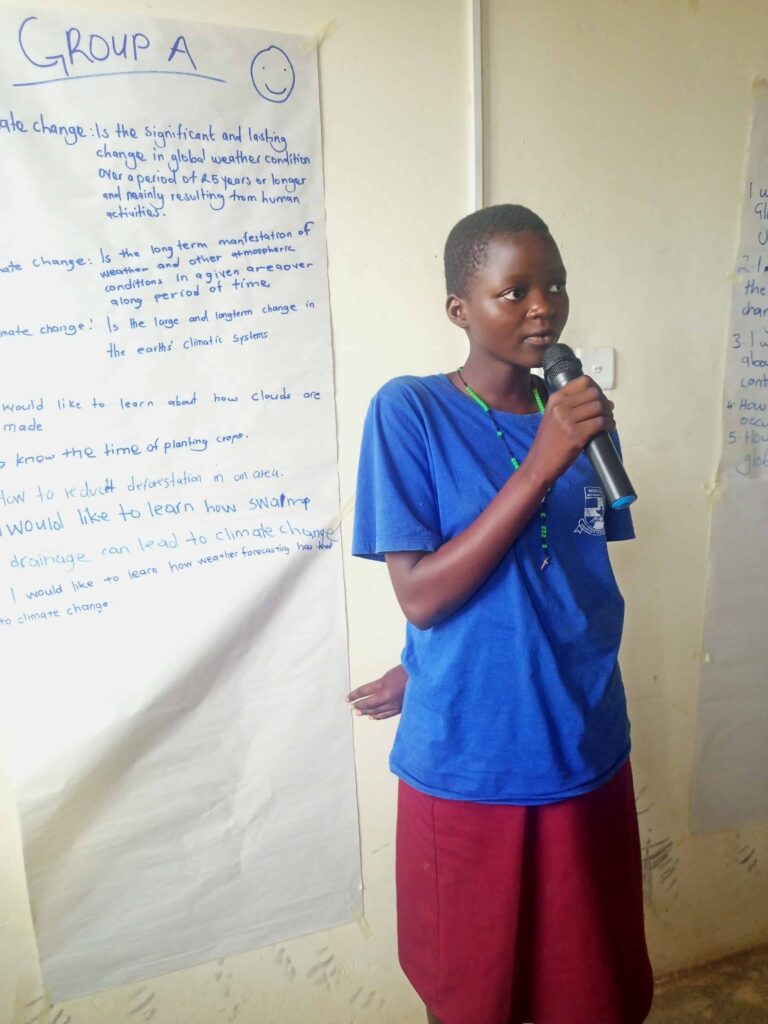
In the second breakout session, the students gave solutions to some of these problems which incude afforestation and reforestation to increase vegetation cover that absorbs carbon dioxide from the atmosphere., sensitization of the community on environmental conservation and preservation, building of fishponds to increase the water table and provide alternative source of income, use of alternative sources of energy like solar, hydroelectricity power, wind to avoid over dependency on wood fuel, separation of biodegradable and non-biodegradable materials to encourage recycling of wastes, irrigation of dry areas to increase vegetation cover and limit swamp drainage.

For the third and fourth sessions, they engaged in composing and singing songs and poems that sends a message to man’s attitude towards conservation of the environment and finally they was a display of art work and drama on climate change, that cebtered on solutions to climate change. The students resolved to continually impact their communities with the lessons they learnt.
