
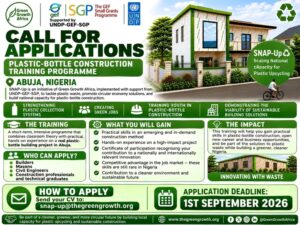
Strategic Context: This analytical paper addresses the “SNAP-Up” Initiative Scaling National Capacity for Plastic Upcycling—designed by Green Growth Africa in Abuja, Nigeria, with core partnership support from the UNDP-GEF-SGP. This paper explores the structural mechanics of plastic masonry, localized financial inclusion pipelines, and municipal policy recommendations required to mainstream alternative eco-construction across sub-Saharan Africa. The official application deadline for the Abuja training cohort is September 1, 2026.
Introduction: The Urban Waste Paradox in the Global South
Plastics constitute a major share of materials and consumables for socioeconomic uses and applications across the globe. However, the unprecedented increase in the use of plastics, especially single-use plastic products for diverse applications, has significantly increased global plastic production from 1.5 million tons in 1950 to 400.3 million tons by 2022(Geyer et al., 2017; Nature Communications Earth & Environment, 2025). This trajectory is projected to rise to an alarming 640 million tons by 2050 if left unmitigated(OECD, 2022; Statista, 2025).
According to data compiled by the United Nations Environment Programme (UNEP) and widely cited sources, one million plastic bottles are purchased every minute, while approximately five trillion plastic bags are used annually around the globe (UNEP; Plastic Soup Foundation and related compilations). Plastics currently account for roughly 300–400 million tons of waste annually a volume frequently compared to the approximate weight of the entire human population (Our World in Data; Plastic Pollution Coalition). Empirical studies reveal that more than 8.3 billion metric tons of plastics have been produced since the early 1950s (as of 2015), of which about 60% ended up in landfills or the natural environment, causing severe systemic environmental pollution due to their characteristic non-biodegradability and inadequate global recycling capacity (Geyer et al., 2017).
While the challenge of plastic pollution remains global, developing Asian and African countries rank highest in acute plastic pollution. This is driven by inefficient, inadequate, and in some cases a total absence of waste collection and recycling infrastructure. Based on OECD modelling (2019 baselines), plastics use is projected to grow by a factor of approximately six (roughly 500%+) in Sub-Saharan Africa by 2060, compared with a near-tripling globally (OECD, 2022). Despite the increasing demand and use of plastic in Africa, plastic recycling capacity remains abysmally low on the continent. Currently, only around 12% (or lower in some estimates) of plastic waste generated in sub-Saharan Africa is recycled (Impact Canada / Afri-Plastics Challenge; various regional assessments).
The crisis is highly localized in key trade hubs: River Niger, the longest river in West Africa which has a major share of its course in Nigeria, ranks among the top ten rivers that contribute to 90% of plastic waste that ends up in the oceans around the globe(Schmidt et al., 2017). Plastic pollution constitutes significant harm to the air, water quality, aquatic populations, and land ecosystems due to its non-biodegradability and toxicity. Therefore, the possibility of addressing plastic pollution in Africa relies largely on local and indigenous innovative capacity for recycling and upcycling of plastic waste into functional structural materials to meet pressing social and economic needs on the continent.
The SNAP-Up Mandate: Institutional Framework and Target Cohorts
To transform this systemic environmental liability into an infrastructural asset, Green Growth Africa launched the SNAP-Up initiative (Scaling National Capacity for Plastic Upcycling) based in Abuja, Nigeria. Implemented with active support from the United Nations Development Programme, the Global Environment Facility, and the Small Grants Programme (UNDP-GEF-SGP), SNAP-Up serves as a blueprint for alternative masonry.
The structural blueprint of the campaign targets four primary programmatic axes:
- Strengthening Plastic Collection Systems: Building efficient municipal source-separation networks to intercept post-consumer PET bottles before they wash into drainage systems and river basins.
- Creating Green Jobs: Upgrading informal plastic collection into structured, safer green employment pathways for urban youth and marginalized women’s cooperatives.
- Training Youth in Plastic-Bottle Construction: Equipping a new generation of artisans with precise technical capabilities that bridge classroom engineering theory with real-world field experience.
- Demonstrating Viability: Constructing high-durability, load-bearing community centers and buildings to prove the market viability of alternative building methods.
To ensure long-term integration into national infrastructure planning, the project narrows its recruitment parameters to target individuals with direct control over design specifications. The targeted demographic cohorts comprise four distinct professional lines: Builders, Masons, Civil Engineers, and Construction Professionals / Technical Graduates. The intensive program fuses classroom theory with hands-on practice on a live plastic-bottle construction site in Abuja.
The Engineering Mechanics of Plastic-Bottle Architecture
Using sand-packed PET bottles as alternative masonry blocks depends on basic soil mechanics and polymer protection principles. When packed correctly, a plastic container switches from a flexible piece of consumer packaging into a highly solid structural brick that is resistant to heavy compression forces.
The Four-Stage Technical Lifecycle:
- Compaction and Density Testing: Recovered PET bottles are washed, dried, and tightly packed with fine, dry river sand or non-cohesive soil. Workers use manual ramming rods to compress the sand matrix until it reaches maximum density. A fully compacted, sand-filled bottle achieves high compressive strength, rivaling traditional sandcrete blocks.
- Horizontal Interlocking Course Design: The finished bottle units are placed horizontally in alternating rows, embedded within a stable mud-mortar or low-carbon cement matrix. Laying the bottles horizontally ensures that vertical dead and live structural loads are evenly distributed across the entire wall surface.
- Tensile Lattice Binding: To protect against lateral wind forces and seismic shear stresses, high-tensile nylon cords or galvanized iron wires are wrapped securely around the caps and necks of the bottles. This links the units into a single continuous structural grid, preventing blocks from moving independently.
- UV and Thermal Plastering Shield: The assembled bottle core is coated with thick layers of cement-sand plaster on both sides. This coating serves two key functions: it blocks ultraviolet (UV) radiation from reaching the internal PET polymers (preventing chemical breakdown over time) and forms a reliable fire-rated barrier.
Technical Performance Comparison Metrics:
- Compressive Strength Profile: Traditional non-load-bearingsandcreteblocks used across West Africa typically average between 2.0 to 3.5 MPa. In comparison, a well-compacted, sand-packed bottle module can achieve 4.0 to 5.5 MPa, making them strong enough to support single-story and two-story residential or institutional buildings.
- Thermal Insulation Capabilities: Conventional concrete blockspossesshigh thermal mass and conductivity, storing and radiating solar heat into interiors. Sand-packed bottles act as natural insulation, reducing interior temperatures by 4°C to 6°C and cutting down the energy needed for mechanical cooling.
- Structural Cost Variance: Manufacturing concrete requires energy-intensive quarrying and cement processing. Upcycled PET bottle walls can reduce raw structural material expenses by up to 45%,providingan affordable option for public infrastructure.
Socio-Economic and Environmental Impact Metrics
Scaling this alternative building system via the SNAP-Up project delivers measurable impacts across three main categories:
- Permanent Pollution Isolation: A standard two-bedroom residential structure upcycles roughly 14,000 to 15,000 plastic bottles. This effectively captures and isolates non-biodegradable waste inside permanent structural walls for decades, preventing it from fragmenting into microplastics or leaking into critical waterways like the River Niger.
- Green Job Creation and Inclusion: Establishing a formal collection, washing, sorting, and compacting supply chain creates reliable green income streams for low-income youths and women’s cooperatives, turning environmental waste into an accessible asset class.
- Alleviating the Housing Deficit: Nigeria currently faces a severe housing deficit, driven by the high cost of conventional construction materials. Upcycled masonry makes public construction such as rural primary health clinics, public schools, and community centers substantially more affordable for municipal governments.
Policy Roadmap: Strategy for Institutionalization
To transition plastic-bottle masonry from isolated pilot projects into mainstream civil engineering practice, municipal and national leadership must implement targeted policy interventions:
- Regulatory Code Integration: The Council for the Regulation of Engineering in Nigeria (COREN) and the Nigerian Society of Engineers should establish formal, standardized building codes for polymer-soil masonry, allowing municipal planning departments to legally approve and oversee eco-construction projects.
- Fiscal Incentives and Procurement Mandates: The Federal Ministry of Environment should introduce tax credits and VAT exemptions for construction companies that incorporate verified upcycled plastic waste into their projects. Public procurement policies should mandate that a minimum percentage of rural community storage buildings and auxiliary facilities use sustainable alternative materials.
- Municipal Resource Integration: The Abuja Environmental Protection Board (AEPB) should partner with collection networks to set up decentralized urban drop-off centers. These centers would pay citizens market-indexed rates for sorted PET waste, providing a reliable material supply line for construction while cleaning up the urban landscape.
Conclusion
The SNAP-Up initiative by Green Growth Africa proves that environmental management can run parallel to economic development and infrastructure expansion. By upcycling post-consumer plastic waste into durable structural assets, the program provides a scalable solution to the overlapping crises of plastic pollution, youth unemployment, and infrastructure deficits across Nigeria.
The program is now accepting formal applications from qualified builders, masons, civil engineers, and construction technical graduates ready to build technical skills in this high-demand circular economy sector. The official deadline for application submission is fixed for September 1, 2026. All applications and curriculum vitae must be submitted electronically via email to snap-up@thegreengrowth.org. By scaling national capacity for plastic upcycling, participants will actively contribute to a cleaner environment, sustainable community development, and a greener future across Africa.

