
A Comprehensive Policy and Practice Framework for Green Growth Africa
Executive Summary: Sub-Saharan Africa’s agricultural landscape is facing unprecedented disruption from climate change. With over 90% of cropland tethered strictly to rain-fed models, millions of smallholder livelihoods are highly vulnerable to volatile weather paradigms. This document analyzes the technical matrix, socio-economic dynamics, and structural limitations of shifting toward Solar-Powered Drip Irrigation (SPDI). It outlines a strategic blueprint for policymakers, financial technology providers, and grassroots institutions to build an all-season, climate-resilient, and green agricultural framework across the continent.
The Vulnerability Structure of African Rain-Fed Agriculture
Agriculture remains the fundamental economic anchor of sub-Saharan Africa, employing over 55-62 percent of the aggregate population and contributing substantially to regional Gross Domestic Product (GDP)(IPCC, 2022). However, this expansive economic engine possesses a systemic vulnerability: over 90 percent of the continent’s arable land is entirely dependent on natural, seasonal rainfall. Historically, this dependency was a manageable constraint governed by predictable seasonal cycles. In the contemporary era of rapid climate destabilization, this reliance has transformed into a critical threat vector to food security and macro-economic stability.
The manifestations of this rain-fed dependency are categorized across three main impact vectors:
- Macroeconomic Volatility: Agricultural outputs are directly coupled with meteorological outcomes. A single macro-regional delay in seasonal precipitation can compress an agrarian nation’s annual agricultural GDP by 15 to 20 percent. This creates immediate shockwaves throughout secondary markets, restricting public spending and degrading national trade balances.
- Market Paradoxes and Price Instability: Because regional smallholders operate on identical, weather-dependent production calendars, harvests hit local markets simultaneously. This results in massive seasonal gluts that depress farmgate prices, minimizing farmer revenues. Conversely, during the extended dry seasons, severe supply deficits trigger hyper-inflation for basic food commodities, penalizing urban and rural consumers alike.
- The Resource Inefficiency Crisis: Where irrigation is attempted natively, traditional surface or flood irrigation methodologies predominate. These systems are profoundly inefficient, losing up to 50 percent of extracted water to evaporation and unchanneled surface runoff. This exacerbates localized water table depletion without translating into proportional crop yields.
Technical Paradigm: Solar-Powered Drip Irrigation (SPDI)
Solar-Powered Drip Irrigation (SPDI) represents a sophisticated socio-technical framework that sits at the intersection of renewable energy infrastructure and precision agronomy. The system decouples agricultural water delivery from both the volatility of ambient weather and the unreliability of public electrical grids or fossil-fuel logistics.
System Architecture and Operational Mechanics
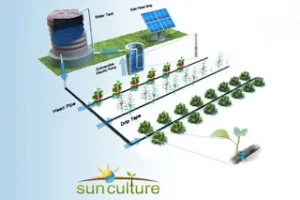
The core functionality of an optimized SPDI setup relies on a synchronized four-stage utility loop:
- Photovoltaic Energy Capture: Polycrystalline or monocrystalline solar arrays capture solar irradiance, converting it into direct current (DC) electrical energy. This clean energy generation pathway completely removes the operational dependence on diesel fuel distributions, protecting farmers from macro-economic energy price shocks.
- Submersible Pumping Dynamics: The generated power drives high-efficiency DC or AC submersible pumps tailored to local hydraulic lift requirements. Water is extracted seamlessly from secure ground aquifers, deep boreholes, or localized surface catchments and transferred directly into elevated storage tanks.
- Gravitational Storage Systems: By elevating storage reservoirs, the system uses gravitational potential energy rather than active mechanical pressure to drive the downstream distribution network. This radically minimizes mechanical wear and prolongs system operational lifespans.
- Precision Emitter Output: Water moves through specialized filtration units into lateral polyethylene pipelines running parallel to crop configurations. Pressure-compensating emitters deliver micro-doses of water directly to the plant’s root perimeter, maintaining optimal soil moisture tension continuously.

Quantifiable Environmental and Resource Efficiencies
- High Water Conservation Metrics: By eliminating atmospheric evaporation during distribution, SPDI achieves localized water application efficiency rates exceeding 90 percent. This compares with a dismal 40 to 50 percent efficiency typical of traditional open-channel flooding methods.
- Advanced Fertigation Capabilities: SPDI allows for the precise integration of water-soluble macronutrients directly into the irrigation stream. This micro-dosing mechanism limits fertilizer volumetric waste by approximately 30 percent, preventing unnecessary soil acidification and avoiding downstream chemical contamination of localized watersheds.
- Substantial Carbon Mitigation: Transitioning smallholder agricultural landscapes away from mechanized diesel pump networks eliminates significant carbon inputs. Empirically, replacing a single standard 5-horsepower diesel pump with a solar array prevents the emission of 1.5 to 2.5 metric tons of CO2 equivalents per annum.
Macro Socio-Economic Impacts on Agribusiness Lifecycles
The transition from defensive, survival-based rain-fed farming to active, technology-enabled SPDI models fundamentally reconstructs the economic lifecycle of the rural household, transforming subsistence holdings into profitable commercial operations.
Key socio-economic transitions include:
- Transition to Continuous Production Cycle: SPDI empowers smallholder farmers to break the single-harvest cycle, enabling up to three complete cultivation periods annually. Crucially, this gives farmers the capacity to target high-value horticulture (e.g., specific varieties of capsicums, brassicas, and solanaceous crops) during peak dry-season periods, capturing premium pricing when open-market supplies collapse.
- Exponential Volumetric Yield Growth: Because plants are shielded from water stress throughout their vegetative and reproductive lifecycles, crop consistency improves dramatically. Empirical pilot evaluations across West and East Africa indicate aggregate yield increases of up to 100 percent per unit of land cultivated.
- Labor Rationalization and Social Equity: Traditional manual irrigation models are profoundly labor-intensive, drawing heavily on uncompensated domestic labor typically provided by women and children. This dynamic entrenches intergenerational educational poverty. SPDI automates distribution dynamics, redirecting valuable hours toward education and formalized off-farm commercial ventures.
Structural Bottlenecks Restricting Micro-Scale Penetration
Despite compelling technical, ecological, and economic justifications, the aggregate penetration of localized drip irrigation frameworks across sub-Saharan Africa remains structurally stalled below 5 percent of total cultivated area. Scaling this technology requires resolving three distinct systemic barriers:
- Prohibitive Upfront Capital Expenditure (CapEx): The acquisition cost for a high-efficiency solar pump array, filtration infrastructure, and basic drip lateral lines ranges between $800 to $2,500 per hectare. For smallholder farmers with average annualized disposable incomes below $400, this initial capital requirement creates an insurmountable financial barrier without external intervention (market data from Kenya and East African suppliers; project reports).
- Technical Literacy and Maintenance Deprivation: Modern SPDI networks require specialized technical maintenance knowledge, including managing PV array degradation, repairing solar inverter controllers, optimizing emitter pressure differentials, and conducting chemical line flushes to prevent mineral clogging. Rural distribution networks suffer from an acute shortage of localized technical expertise.
- Supply Chain Fragmentation: Rural agrosystems across the continent rarely stock essential technical replacement components. When basic components like filters, specialized valves, or UV-resistant lateral lines fail, smallholders face prolonged system downtimes, often invalidating entire seasonal crop investments due to localized supply chain failures.
A Strategic Roadmap for Policy and Market Scaling
Accelerating the adoption of SPDI from a niche novelty to a dominant agricultural utility requires a coordinated, multi-stakeholder strategy that links financial innovation, structural organization, and macro-policy interventions.
- Financial Innovation via Pay-As-You-Go (PAYG) Digitization
Traditional banking institutions regularly exclude smallholder farmers due to perceived risk profiles and lack of formal collateral. To bridge this structural divide, asset-financing models must integrate with existing regional mobile money networks. By employing Pay-As-You-Go (PAYG) frameworks, farmers can acquire functional SPDI infrastructure via an affordable initial down payment. The remaining financial balance is amortized into flexible weekly or monthly micro-payments directly linked to the cash-flows of their dry-season crop sales, converting an overwhelming CapEx hurdle into a manageable operational expense (SunCulture / Global Energy Allience; AICCRA Mali case; IWMI reports).
- Community Agribusiness Cooperatives
Individual smallholdings are frequently too fragmented to achieve true economies of scale. Institutional frameworks should focus on clustering contiguous smallholder farms into formalized community agribusiness cooperatives. These cooperatives can pool capital to invest in high-capacity centralized solar pumping hubs, distribution reservoirs, and shared filtration systems. This structural approach minimizes per-farmer capital exposure, simplifies training delivery, and creates localized bulk-selling power when bringing harvests to primary corporate buyers.
- Macro-Policy and Tariff Modernization
National governments across Africa must realign fiscal policy to match environmental goals. Solar panels, agricultural DC pumps, and precision irrigation hardware should be legally reclassified as primary national development goods. This status should grant them complete exemption from import tariffs, customs duties, and local Value-Added Tax (VAT). Removing these fiscal barriers can instantly lower retail prices across rural supply chains by 15 to 25 percent, accelerating organic market adoption.
Conclusion
The long-term development path of African agriculture must change from defensive, climate-vulnerable survival to active, technology-driven resilience. Solar-Powered Drip Irrigation is not a minor luxury for high-end agribusinesses; it is a critical infrastructure requirement for continental food sovereignty, rural wealth generation, and active carbon mitigation. For progressive organizations like Green Growth Africa, driving the adoption of this precision infrastructure through bold policy advocacy and grass-roots implementation models represents the core work of building a truly sustainable, climate-smart continent.

