
We are thrilled to share a monumental moment in the journey of Green Growth Africa. In a series of significant events, our organization had the distinct honour of hosting His Excellency Daniel Krull, Consul General of the German Consulate General in Lagos, at the Green Growth Hub in Ibadan. His visit marked a significant milestone in strengthening collaboration between Green Growth Africa and the German Government, while highlighting the growing importance of practical solutions for sustainable development and circularity in Nigeria.
With great excitement and gratitude, Green Growth Africa officially signed its first formal partnership with the Government of the Federal Republic of Germany to implement the groundbreaking Circular Agriculture Project (CAP) in Ibadan, Nigeria. The project represents an important step towards advancing circular agricultural practices, strengthening sustainable livelihoods, and contributing to a more resilient and environmentally sustainable future.
A Walk ThroughWalk-Through Innovation: The Tour of the Ibadan Green Growth Hub, Ibadan
During the historic visit, the Consul General was taken on an extensive tour of the Green Growth Hub and its surrounding premises in Lagbeja-Akingbile, Ibadan. The tour included a detailed walkthrough of the organization’s office facilities and a close inspection of the land proposed for the implementation of CAP. This visit offered a firsthand opportunity to see one of the practical initiatives through which Green Growth Africa advances its vision of “reimagining African development”.sustainable and innovative development.
The definitive highlight of the tour was the Hub’s world-class plastic-bottle building, a striking architectural architectural masterpiece achievement that demonstrates how waste materials can be completely repurposed for sustainable construction. Constructed from 27,333 waste plastic bottles instead of conventional sandcrete blocks, the green building is stronger and cheaper than those made from conventional sandcrete blocks. Research from Massachusetts Institute of Technology (MIT) shows that buildings developed from waste plastic bottles are bulletproof, fireproof and earthquake resistant. The building is integrated with with a biodigester system for waste management instead of the conventional soakaway and it is offgrid – fully powered by solar energy.
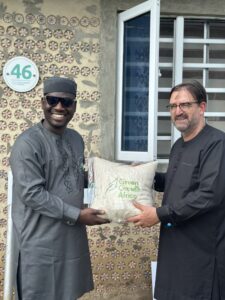
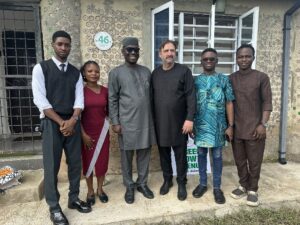
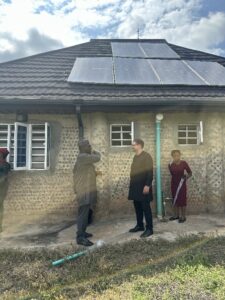
Inside Our 27,333 Plastic-Bottle Building & Eco-Facilities
Green Growth Africa developed has documented this building as a prime example of transforming plastic environmental hazards into functional, durable infrastructure. Every detail of the facility left leaves an impression:
- The Bottle-Brick ArchitectureBuilding: The entire building was developed using an astonishing 27,333 waste plastic bottles, which were carefully packed filled with soillaterite and repurposed as “bottle-bricks” for during construction of the building. This technique provides incredible structural integrity and natural insulation while keeping thousands of plastic materials out of landfills and oceans.


- A Tangible Demonstration: During the tour, the Consul General was shown remnants of the exact plastic bottles used in the construction. This offered a fascinating, tangible illustration of the raw waste materials that were successfully upcycled into the walls of the building. The sample bottle brick was picked from the floor of the undeveloped portion of the land within the fence of the building. That the bottle is filled with laterite with no cap (no bottle bottle) and lying on the ground since 2022 yet the laterite did not pour out of the bottle till date demonstrate the strength of the bottle brick.
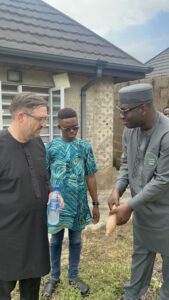
- 100% Off-Grid Solar Power: Walking through the office facilities, the Consul General experienced our clean energy infrastructure in action. The Hub operates entirely on an off-grid solar photovoltaic energy system. This eliminates any reliance on erratic grid electricity or polluting diesel generators, significantly reducing the facility’s carbon footprint and operational costs.

- Water and Security Assets: The facility features automated reliable borehole water system designed to supply clean, regular water, alongside a fully fenced layout with two secure gates to safeguard the site’s office operations and upcoming agricultural assets.
- Strategy for Lifelong Learning in Education for Sustainable Development: Green Growth Africa also named nine streets with different themes within Green Growth Framework. The street names are Green Growth Avenue, Climate Close, Sustainability Close, Circularity Close, Nature Close, Conversation Close, Biodiversity Close, E-Mobility Close and Resilience Close. All the houses on the nine streets were numbered accordingly, e.g. 27, Climate Close; 5, Circularity Close, among others. This means that as long as the buildings and streets exists, the buildings and street serve as a strategic means to educate all children and adult who live and will live in the building on sustainability concept. Children from the streets have been seen asking their parents and members of Green Growth Africa’s team about the meaning of these themes which also facilitate further discussion and education. As an additional social, economic and environmental value to the street, Green Growth Africa also installed solar streetlights on all the nine streets that were named with Green Growth themes.

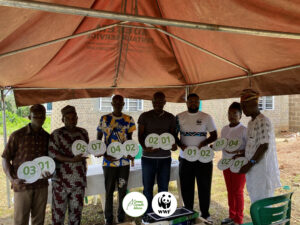
The Green Growth Hub serves as a demonstration masterpiece and model on green building in Nigeria. The holistically concept of the building demonstrates how green buildings could provide social, economic and environmental capitals – green growth – when properly conceptualized and implemented. is not merely as a venue for a diplomatic meeting, but as a living, breathing proof-of-concept for the green transition in Africa.
Inside CAP: A Five-Component Closed-Loop Model
In scaling the circularity and sustainability concepts of the Green Growth Hub, the Circular Agriculture Project (CAP) is being implemented within the facilityWhile CAP is a small-scale project, its scientific and environmental significance is massive. . It is designed around the principles of resource efficiency and zero waste. Powered entirely by our renewable solar grid, CAP the integrated farming technology connects five distinct farming sub-systems into a single, highly efficient closed-loop network:

- Poultry Production (Layers): Provides a consistent flow of organic waste (droppings) rich in vital nutrients like Nitrogen, Phosphorus, and Potassium (N.P.K.).
- Black Soldier Fly (BSF) Farming: The BSF unit biologically processes the poultry droppings, converting them into protein-rich larvae (to supplement animal feed) and frass (organic fertilizer).
- Fishery (Catfish): Well-suited for local markets, the fish benefit from the BSF larvae feed.
- Aquatic Plant (Duckweed) Production: Cultivated on top of the fishponds, duckweed acts as a nutrient recovery technology, absorbing nitrogen and phosphorus from the wastewater to be recycled back into poultry feed.
- Crop Cultivation (Vegetables): High-value crops like tomatoes and peppers will be irrigated using nutrient-rich fishpond wastewater and fertilized by the BSF frass, while vegetable residues will go back into poultry feed.
Why This Location?
The site chosen for CAP is located in Akingbile, right behind the International Institute for Tropical Agriculture (IITA). This location is strategic because it allows the project to seamlessly integrate with the Hub’s existing infrastructure, including the fenced land, borehole water system, and our solar grid (which will be upgraded to support the farm’s load). Furthermore, its proximity to IITA and the University of Ibadan opens up incredible opportunities for future collaborations in research, learning, and community outreach.
From Demonstration to Community Impact
Beyond farming production, CAP is built to be a scalable demonstration plotand replicable project. It will serve as an experiential learning hub for local smallholder farmers, youth, and students. We look forward to hosting school excursions, student internships, and research projects that will help drive a just, green transition and create direct and indirect jobs within our community.
Looking Ahead: CAP Takes Off Soon!
With the groundwork laid, the agreements signed, and a shared vision firmly established, the Circular Agriculture Project (CAP) is now poised to move from planning into implementation. Backed by the Government of the Federal Republic of Germany, alongside Green Growth Africa’s complementary resources and commitment, CAP will officially take off soon in Ibadan, translating the shared vision for sustainable and circular agriculture into practical action, while attracting and welcoming other partners. .
Green Growth Africa extends its sincere appreciation to His Excellency Daniel Krull, Consul General of the German Consulate General in Lagos, and the Government of the Federal Republic of Germany for their trust, partnership, and support in advancing this important initiative. As the project moves into its implementation phase, Green Growth Africa looks forward to sharing updates, photographs, and stories from the field as CAP begins to take shape and contributes to more sustainable agricultural practices, resilient livelihoods, and a greener future for communities in Ibadan and beyond.

