
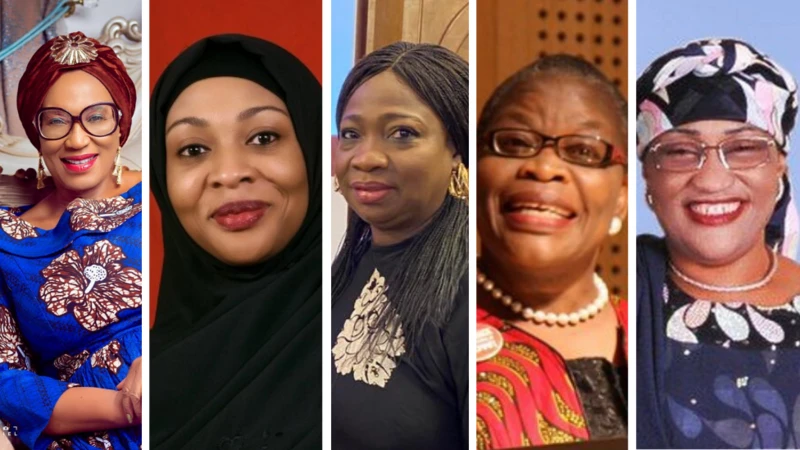
Source: BBC News Pidgin
Not too long ago, a Nigerian President told women that they belonged to the kitchen and the other room. Less than 10 years later, Diolu Tobechukwu Prosper, Co-founder of Linc-green Initiative, is saying that “Nigerian women deserve more than just the kitchen”.
More than 100 million women shape Nigerian families, economies, and communities, yet their presence in legislative chambers where decisions are made is almost invisible. Women make up less than 5% of lawmakers in the National Assembly, a statistic that places the country among the lowest in the world and dead last in Africa for female political representation. This imbalance is more than a numbers problem; it reflects how deep structural and cultural barriers have kept women on the sidelines of decision making in Nigeria for decades.
A new legislative proposal, House Bill 1349, seeks to change that reality. It offers a bold and innovative approach to addressing gender inequality in governance by reserving seats for women in Nigeria’s federal and state legislatures.
This blog will unpack the exclusion of women in Nigerian politics, the purpose and potential impact of the bill, while also exploring the broader cultural shifts it hopes to ignite in the Nigerian political system.
Key Highlights
- Nigeria’s Legacy of Women Exclusion
- Reserved Seats as a Strategic Intervention
- Shifting Attitudes Through Grassroots Engagement
- Toward More Inclusive Governance
Nigeria’s Legacy of Women Marginalization
The marginalization of women in Nigerian politics is not the result of individual choices but the product of long-established systems. Cultural and religious norms, coupled with institutional biases, have long confined women to domestic roles and discouraged them from entering public life. These barriers manifest in unequal access to campaign resources, limited opportunities within political parties, and voter attitudes that question women’s leadership capabilities.
The result is a political system that fails to reflect the society it serves. Women, despite their numbers and contributions, remain excluded from the spaces where key decisions are made. House Bill 1349 emerges as a deliberate intervention; a corrective mechanism aimed at addressing decades of structural inequality rather than waiting for organic change that may take generations.
Reserved Seats as a Strategic Intervention
At the heart of House Bill 1349 is the proposal to reserve seats specifically for women across Nigeria’s legislative bodies. If the bill is passed, it will Create 37 additional seats in the House of Representatives, 37 new seats in the Senate, and create 108 additional seats across State Houses of Assembly. These 182 seats would be set aside solely for women, without changing existing constituencies or restricting their right to compete in the general elections.
This approach is not simply about boosting statistics. It is about creating real and exclusive opportunities for women to gain experience in governance, and also influence policy in ways that reflect the priorities of half the population.
Shifting Attitudes Through Grassroots Engagement
Legislation alone may not be sufficient enough to transform a longstanding political culture. One of the most persistent challenges to women’s representation in Nigeria is the societal mindset that leadership is a male domain. Overcoming this requires not only legal reforms but also demands cultural change.
Advocates for House Bill 1349 understand this, which is why grassroots mobilization forms a central pillar of the movement. Women at the community level, often excluded from decision-making, will gradually be educated and encouraged to participate in governance. The aim of the efforts will be to challenge and reshape public attitudes from the bottom up and create an environment in which women’s leadership is normalized and accepted.
Toward More Inclusive Governance
The potential impact of increasing women’s representation goes beyond fairness and equity. Research consistently shows that societies with higher female political participation experience more effective governance. Women leaders are more likely to spearhead policies that prioritize education, healthcare, and social welfare, sectors that drive development and improve quality of life.
House Bill 1349 is therefore, not just about representation, it is about transformation. By giving women a stronger voice in governance, Nigeria stands to benefit from leadership that is more empathetic, inclusive, and one that pays good attention to the needs of all citizens.
Conclusion
House Bill 1349 represents an important moment in Nigeria’s democratic journey. It shows that the centuries of exclusion of women cannot be undone without intentional and corrective measures. By combining legislative innovation, with grassroots advocacy, the bill seeks to break the cycle of women’s underrepresentation and lay the foundation for a more equitable political system where women are adequately represented.
Written by: Glory Akenu; Comms Associate, Green Growth TV
This blog is adapted from Green Growth TV’s Policy on the Go Episode 16; with Toni Ogunbanjo of Green Growth TV and Diolu Tobechukwu Prosper, Co-founder, Linc-green Initiative, that premiered on August 6, 2025. Watch the full episode here!

