
What do human trafficking, drug trafficking, and environmental crimes have in common?
They all are leading organised crimes in the world – according to the United Nations Environment Programme (UNEP); with environmental crimes and violations costing Africa up to 194 billion USD annually. And that is not all: for the over 70% of people living in sub-Saharan Africa who depend on forests and grasslands for their food and livelihoods, environmental crimes threaten their food security, jobs, and incomes. These illicit activities not only devastate ecosystems and the lives of millions of Africans dependent on ecosystem services but also fuel corruption, promote money laundering, and weaken the rule of law.
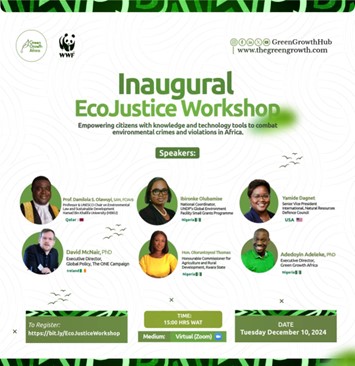
Given these untold consequences of the unbridled growth of environmental crimes in Africa, Green Growth Africa organised the Inaugural EcoJustice Workshop on Tuesday, December 10 2024, as a capacity-building virtual event to educate and empower rights holders (youth, women, and indigenous communities), civil society organisations, researchers, and other stakeholders on environmental rights, crimes/violations and justice in the African context and its impact on national and continental development – including the SDGs and Agenda 2063 of the African Union. The workshop also served as the official launch of the “EcoJustice Africa” initiative. EcoJustice Africa is a people-powered and technology-driven initiative aimed at empowering citizens with knowledge and technology tools to combat environmental crimes and violations in Africa.
The 2-hour long Inaugural EcoJustice Workshop was facilitated by leading environmental justice and green growth experts: Yamide Dagnet, Senior Vice President International, Natural Resources Defence Council; Hon. Oloruntoyosi Thomas, Commissioner for Agriculture and Rural Development, Kwara State, Nigeria; Professor Damilola S. Olawuyi, SAN, FCIArb; UNESCO Chair on Environmental Law and Sustainable Development, Hamad Bin Khalifa University (HBKU), Qatar; Ibironke Olubamise; National Coordinator (Nigeria), UNDP Global Environment Facility Small Grants Programme; David McNair, PhD; Executive Director – Global Policy, The ONE Campaign; and Adedoyin Adeleke, PhD; Founder/Executive Director, Green Growth Africa. These incredible speakers led over 342 diverse participants (233 males; 109 females) from 29 countries in West, East, and Southern Africa, as well as USA, Hungary, Kazakhstan, Thailand, Iran and Qatar – 35 countries in all – through a powerful keynote address and engaging sessions that shed light on the multifaceted dimensions of environmental crimes and the pathways to combating the menace.
Highlights from the Workshop
“Let’s Establish Clear Next Steps,” – Hon. Oloruntoyosi Thomas
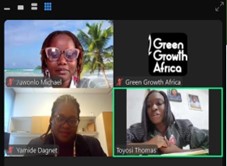 In her succinct goodwill message, Honourable Oloruntoyosi Thomas set the tone for the workshop. She celebrated the participants and facilitators for coming together to dialogue and collaborate to make more impact, and encouraged participants to take advantage of the workshop to learn and network. Concluding, she urged the organisers to “establish clear next steps” from the workshop and expressed her desire to see the innovations that would be produced as a result.
“Evidence not connected to pathways for implementation and to governance will fall short to deliver,” – Yamide Dagnet
Yamide Dagnet, the keynote speaker, opened the workshop by highlighting historic climate hearings that are currently ongoing at the International Court of Justice (ICJ), initiated by young activists from the small island nation of Vanuatu. Dagnet also cited similar litigation efforts by youth in the United States and South Africa, and by elderly women in Switzerland. These grassroots movements, she noted, are inspiring in the face of global geopolitical tensions, such as the just concluded US elections and the outcomes of recent COP negotiations, which had left many vulnerable communities disappointed.
Dagnet further emphasised the need for integrating climate implementation across all sectors and added that evidence must be connected to governance and practical implementation pathways to yield results. She contrasted the state of data collection on environmental crimes in Africa with South American and Caribbean countries where the exact number of environmental defenders killed in the past decade was well documented; revealing that while there are several research papers about Africa on climate and environmental issues, very few are actually written by Africans. Hence, she concluded that combating environmental crimes in Africa requires robust evidence collection methods and strengthening the legal frameworks.
“No African country has specifically recognised environmental crimes or ecocides,” – Professor Damilola Olawuyi, SAN
 In his session, “Environmental Crimes in the African Context: Definition, Scale, and Extent in Africa,” Professor Damilola Olawuyi introduced the concept of environmental crimes, highlighted some drivers of environmental crimes, and analysed the current legislative framework for environmental crimes in Africa. The learned professor of law advocated for all environment-defiling acts that impact ecosystems and humans to be criminalised as against the current administrative fines/civil damages approach. In that light, he lamented the lack of recognition of environmental crimes or ecocide in African legal systems, calling this a major legislative gap.
Further, Professor Olawuyi highlighted the interplay of militancy, climate change, population growth, and forced migration in exacerbating environmental crimes. He proposed integrating national strategies that prevent extremism, support disarmament, enhance data collection, and foster social inclusion to address these challenges. He further emphasised the need for comprehensive governance to address these drivers of environmental crimes, stating that “good governance that integrates national strategies is key to combating environmental crimes in Africa.”
“None of the SDGs can be Achieved Without Addressing Environmental Crimes,” – Ibironke Olubamise
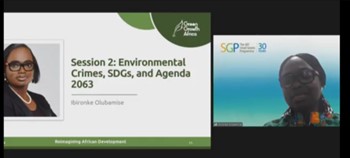 Ibironke Olubamise, in her session on “Environmental Crimes, SDGs, & Agenda 2063,” focused on the systemic barriers to combating environmental crimes, namely ignorance, poverty, and low political will. Using examples from her work and other notable events like the Koko waste incidence in Nigeria, she illustrated the harrowing impacts of hazardous material dumping, wildlife trafficking, and illegal mining on the health, safety, and economic wellbeing of communities and the most vulnerable, particularly youth. On this basis, she noted that none of the SDGs can be achieved without addressing environmental crimes.
To cultivate political will, Olubamise advocated for awareness campaigns targeting the political class while leveraging local actors and indigenous knowledge to drive policy change. She also emphasized the importance of gender mainstreaming and international collaboration in addressing environmental violations. With regards to the Agenda 2063 of the African Union, she remarked that it was critical for Western countries to respect the sovereignty of African nations.
Finally, Olubamise shared examples of innovative projects that the UNDP GEF funded in Nigeria, such as current efforts to grant legal “rights to a river”, inspiring participants to explore creative solutions to environmental justice challenges.
“We Must Push for Tighter Definitions of Climate Finance and Greater Accountability for Where it Goes,” – David McNair
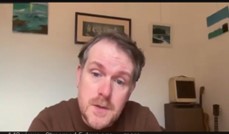 David McNair rounded out the discussion with his session on “The Role of Evidence-based Advocacy for Environmental Justice.” Drawing from his experience with the One Campaign, which has mobilised over $1.2 trillion for people and the planet, McNair emphasised the necessity of evidence-based policy proposals, data collection and tracking, non-partisan political strategy, and citizen activism to compel government action. “If we just make statements as activists, government actors can ignore them. But if you have clear and robust data, it becomes very difficult to ignore,” McNair remarked.
He also extensively discussed the issue of climate finance, calling for tighter definitions and greater accountability in tracking where funds are directed. Moreover, he shed light on Africa’s rising debt burden which limits governments’ ability to finance basic socio-economic sectors as well as combat environmental crimes. As such, external support and transparent climate finance practices are all the more critical in fostering environmental justice in Africa.
Introducing EcoJustice Africa
Finally, Adedoyin Adeleke, PhD, Executive Director of Green Growth Africa, established the necessity of citizen-driven policing in combating environmental crimes in Africa, given that these violations occur mostly in obscure and remote communities. However, the effectiveness of community policing is hampered by the low level of awareness and education about environmental rights and sustainable development by residents of such communities. Moreover, citizen-policing is also limited by the center-periphery relationship between government and the people, the high cost of media coverage, lack of trust in regulatory agencies, and possibilities of victimisation.
Adeleke then introduced the EcoJustice Africa initiative, which combines empowering local actors, environmental education and education for sustainable development, digital technology, media platforms, evidence-based advocacy, and data-driven policy reform and legislative action to combat environmental crimes in Africa. The Initiative encompasses the EcoJustice Fellowship Programme, the Green Growth Watch, and the EcoJustice Situation Room. The EcoJustice Fellowship Programme empowers local environmental actors as “Field EcoFellows” and “Media EcoFellows” with Environmental Education (EE) & Education for Sustainable Development (ESD) as well as digital training to report and amplify environmental issues. The “Green Growth Watch” is a digital eye-witness reporting tool to enable citizens to capture, document, and report audiovisual evidence of environmental crimes and related events within their localities in real time, anonymously! When citizen reports are submitted via the mobile application, Green Growth Watch, they are received at the EcoJustice Situation Room where each reported case is verified using advanced technology and stakeholder collaboration. Verified cases are then escalated for advocacy through direct stakeholder engagement, social media campaigns, Green Growth Television, and collaboration with mainstream media houses where they feature in news reports, debates, and dialogues—driving both grassroots actions and policy reforms.
Conclusion
The Inaugural EcoJustice Workshop was a resounding call for action on tackling the menace of environmental crimes in Africa, and many insights from the speakers on the next steps to take were indeed reflected in various aspects of the EcoJustice Africa initiative launched at the event. Moreover, the workshop served as an awareness-creation and capacity-building platform on environmental rights and justice. Several participants – who all received certificates of participation – expressed immense gratitude for the knowledge gained at the workshop via email, LinkedIn posts, and our virtual community!
We at Green Growth Africa would also like to say “thank you!!!” once again to the World Wildlife Fund (WWF), for believing in our vision for an Africa free from environmental crimes and violations; to our amazing speakers: Yamide Dagnet, Hon. Oloruntoyosi Thomas, Professor Damilola S. Olawuyi SAN, Ibironke Olubamise, and David McNair, PhD, for the enlightening and insightful sessions; and of course to the 300+ amazing young people, representatives from civil society organisations, researchers, and other actors who joined us from all around Africa and beyond!!! We look forward to doing more in 2025!
The recording of the Inaugural EcoJustice Workshop is available here.

