
An estimated 1.3 billion tonnes of food is wasted globally each year, one third of all food produced for human consumption, according to the Food and Agriculture Organization (FAO) of the United Nations. With a total of 37.9 million tonnes of food being wasted by farmers, food vendors, and food processing industries in Nigeria each year, the FAO estimates the carbon footprint because of food waste is 3.3 billion tonnes of CO2 equivalent per year. Not only oil, diesel and other polluting fuels used to power production machinery and transport vehicles emit greenhouse gases, they are also emitted by food waste itself. Discarded food waste rotting in landfills gives off methane, a potent greenhouse gas 25 times more efficient at trapping heat than carbon dioxide.
Green Growth Africa in partnership with Pratt and Whitney, and the North America Association for Environmental Education (NAAEE) is empowering a 7-student team at Twinkle Stars Secondary School, Benue, Nigeria to produce an agricultural and food waste valorization system driven by the Internet of Things (IoT). The primary objective is to breed Black Soldier flies through the valorization system using food and agricultural waste to produce livestock feed and organic fertilizer for farming. The student-team, with guidance of coordinating teachers and a technical advisor, aims to address the significant environmental and economic challenges caused by this issue.
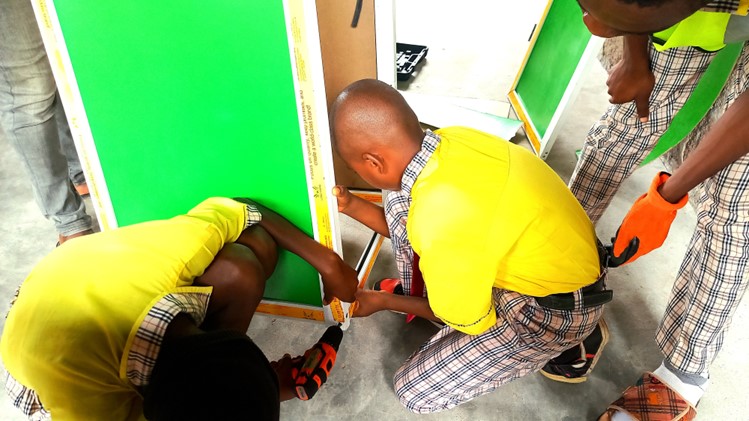
In implementing the Black Soldier Hive project, for the first stage, the team sourced for the materials locally, showing that the valorization system can be easily done by anyone. In constructing the hive using their classroom knowledge in STEM, they made use of an aluminum angle bar as a frame, with an Arduino nano microcontroller and humidity sensor to process automation and for weather control respectively. Currently working on the second stage where bred black soldier fly will convert the waste to livestock feed and organic fertilizer. The Black fly will be bred in a plastic diary crate and the entire system will be powered by a 12-volt solar panel for effective breeding.

Their project strongly aligns with the goals of sustainability, particularly in combating climate change and promoting sustainable agriculture. By harnessing the potential of the Black Soldier Hive, it is believed it will significantly reduce greenhouse gas emissions, especially methane, which is the world’s second-highest contributor to global warming. Once fully operational, this solution has the potential to reduce food waste by up to 37.9 million tonnes annually and provide a sustainable source of nutrition-rich livestock feed and organic fertilizer.
The Black Soldier Hive project shows the teams dedication to environmental sustainability and innovative solutions. By harnessing the potential of biotechnology and circular economy principles, revolutionizing organic waste management, reducing pollution, and promoting sustainable agriculture is possible.
Reported by: Joseph Orya
Blog developed by: Rejoice Asubiojo

