
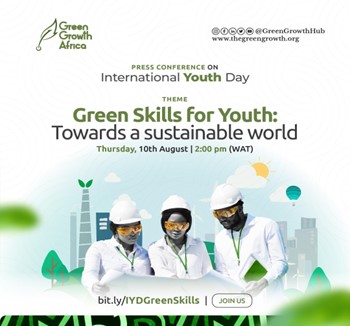
Africa’s burgeoning youth population, accounting for more than 60% of its inhabitants and estimated to reach almost half of the world’s youth population in 2030, presents an exciting avenue for sustainable socio-economic development of the continent. However, the region grapples with formidable challenges such as poverty and educational deficiencies that dampen the enthusiasm, resilience, and exploratory spirit of the African youth. This was the background for Green Growth Africa’s Press Conference ahead of the International Youth Day, 2023, an advocacy event in line with the theme: “Green Skills for Youth: Towards a Sustainable World” that took place virtually via Zoom on Thursday, August 10, 2023. Over ten of Nigeria’s leading media houses were represented at the event, including The Guardian Nigeria, The Punch, The Nation, Vanguard, The Nigerian Tribune, This Day, among others.
 Delivering the press briefing, the Executive Director of Green Growth Africa, Adedoyin Adeleke, PHD, highlighted that despite the continent’s immense potential as a result of its high youth demographic, a stark reality persists: more than 546 million individuals in Africa live in dire poverty, further exacerbating the global poverty crisis. Moreover, the educational systems across Africa have faltered in equipping its youth with the practical skills necessary for innovation and job creation. The consequences manifest in worsening unemployment rates as witnessed in Nigeria’s staggering 53% youth unemployment rate in 2022. Unfortunately, the current climate crisis disproportionately plaguing Africa has resulted in the loss of thousands of lives through floods and droughts. These incidents result in significant economic losses, extreme hunger, internal displacement, among others, further compounding Africa’s development predicament. As Adedoyin Adeleke, PHD, asserted, “With the perennial development deficit in Africa compounded by the climate crisis, the youth are not allowed to breathe.”
However, there is a silver lining: addressing climate change not only presents challenges but also offers uncharted opportunities for Africa’s advancement, provided that swift and decisive action is taken. These opportunities lie in embracing the Green Transition. Although the prevailing narrative often erroneously pits Decarbonisation against Development, it is crucial to acknowledge that as the world transitions to net-zero carbon emissions, the reliance of important African economies like Nigeria on fossil fuels will spell economic doom. Nonetheless, given that Africa’s share of the global carbon emissions is insignificant, the conventional single-sector approach to combating climate change will also have negative socio-economic impact as African economies are largely fragile and non-dynamic. Climate change might be a universal challenge, but it requires differentiated responsibilities.
“Therefore, what Africa needs is not just climate solutions, but climate solutions that also address pressing socio-economic needs,” Dr. Adeleke noted, “Africa needs innovative climate solutions that can enable the continent to be more resilient to climate disasters while maximising the economic benefits of the global green transition – Green Growth. And here lies where the African youth can contribute and gain globally competitive advantage in the fight against climate change. But how? By taking unconventional climate actions to take advantage of Climate Opportunities!”

This echoes the 2023 joint report by Arup and Oxford Economics that the global green transition is poised to catalyse the emergence of new industries worth a staggering $10.3 trillion by 2050. The rising demand for electric vehicles, renewable energy generation, clean energy infrastructure, sustainable fuels, as well as green finance and auxiliary services supporting global supply chains are examples. On the other hand, Africa is well-positioned to lead the green transition by leveraging our huge resources: from our rich mineral reserves of Lithium used to make batteries that power electric vehicles, to our abundant human resources embodied in our youth that can supply quality labour not just to the continent but to other regions across the globe. For Africa, harnessing the exuberance, resilience, and curiosity of its youth hinges on arming them with Green Skills. This is why Green Growth Africa has empowered more than 5,000 youth in 26 African countries on green innovation and technologies, many of which have attracted awards from government, private sector and NGOs in the USA, United Kingdom, Japan, Ghana and Cameroon.
Africa needs innovative climate solutions that can enable the continent to be more resilient to climate disasters while maximising the economic benefits of the global green transition – Green Growth.
In addition, Green Growth Africa recognised that the African youth needs to acquire green skills and be supported to develop home-grown technologies and set up middle and large scale green enterprises that advance social and economic growth. However, this means that African countries will need the necessary finance. As such, we called on the developed nations to redeem their USD 100 billion dollar pledge for the Climate Fund agreed in COP21, financial pledges made to the Adaptation Fund in COP26, and the recent loss and damage fund agreed to at COP27. Ahead of the Africa Climate Week taking place in September, we also recommended African policymakers need to find innovative ways to mobilise public, private, and concessional finance for strategic and multisectoral Green Growth interventions led by young people.
Finally, the briefing concluded with five key takeaways:
- African countries need to see decarbonisation as a catalyst, not a countermeasure, to socio-economic development.
- Empowering young Africans with Green Skills unlocks their potential to innovate and spearhead novel climate interventions that not only curtail carbon emissions but also foster social and economic capital growth.
- Africa’s educational systems must be overhauled to reflect current development shifts and arm young people with green skills for the future of work.
- Governments, the private sector, multilateral institutions, international entities, and civil society must synergise efforts to channel financial resources into nurturing Green Skills among the youth.
- Ultimately, African youth were summoned to harness their full potential to propel the continent to global leadership in climate action.
Within the next two days, reports on the Press Conference by the media houses in attendance were published. These include: “Green economy, $100b climate pledge offer hope for youth employment” by The Guardian Nigeria, “Africa Must Seek to Reap from $10.3tn Global Climate Opportunities, Say Renewables Advocates” by This Day, “Developed nations urged to release $100b climate change fund” by The Nation, “Africa: Cost of climate change to hit N50bn yearly by 2050, group warns” by Vanguard; “Leverage $10.3trn Net Zero Economy To Reduce Nigeria’s Youth Unemployment” by Leadership, “Green economy: Fulfil $100bn climate fund pledge; stakeholders beg US, others” by The Nigerian Tribune; among others that are most read news in Nigeria with millions of impressions combined. It was also reposted on blogs such as Development Diaries and Newsheadlines. In addition, some journalists also noted that the conference exposed them to fresh perspectives on climate discourse and reporting. Indeed, this advocacy event was a vital step to accelerate conversations around green transition that works for youth in Africa and draw the attention of policymakers to the need for greater investment and support for youth-focused green skill development initiatives on the continent!


Other highlights from the event

