
As Green Growth Africa drew the curtains over the illustrious EcoHeroes 2022/2023 cohort this October, we hosted 2 editions of the virtual Intercontinental Knowledge Sharing Workshop in collaboration with Nysmith School, USA and Climate Youth Japan. This knowledge-sharing workshop is a core aspect of the EcoHeroes Initiative that provides a platform for our student-beneficiaries to share their project achievements and new ESD and E-STEM learning with other young people from the global North. In addition to enabling our students to reflect on their project-based learning, which is an important component of active learning, it also inspires other young people to take sustainable actions!
At the first edition with the award-winning Nysmith School in Virginia, USA, over 185 students (93 males, 92 females), from 7 schools across Africa and North America participated in the two-day workshop hosted on Zoom between 11th and 12th October, 2023. In addition, 32 teachers (15 males,17 females), 3 Expert Advisors mentoring the school teams, and 3 external individuals were in attendance, bringing the total number of attendees to 223!
The student teams presented their projects over two days. On the first day, Etefop TSS School’ student team from Musanze, Rwanda shared how they constructed a 3500 litre eco-tank by recycling tonnes of waste plastic bottles into eco-bricks to promote rainwater harvesting. Then, the AMMKK1 School students from New Bussa, Nigeria demonstrated how they saved 36,600 plastic sachets from reaching the streets, landfills, or being incinerated by upcycling some to produce 100 school bags for children from lower-income backgrounds who had none. The attendees also learnt about the innovative project by the Kaimosi Girls High School students from Kenya which aimed to increase farm yields by recycling farm and food wastes into liquid and solid fertilizers.
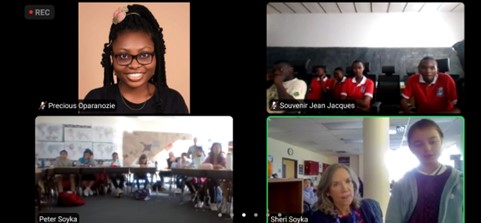
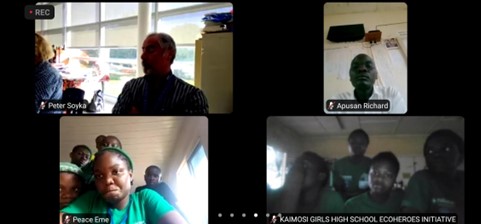
Some snapshots from Day 1
The second day had attendees fascinated with equally exciting projects! First, students from Fruitful Vines College in Ibadan, Nigeria, shared their journey of constructing an aircraft powered by solar-charged batteries as a groundbreaking path to promoting sustainable energy transition in aviation. Next, the Twinkle Stars Secondary School team from Makurdi, Nigeria, demonstrated their valorization system of breeding black soldier fly fed completely on food waste to produce organic fertilizers and livestock feed to reduce methane emissions and eliminate food wastage in Nigeria. Finally, the Imperial College Students from Imo, Nigeria, presented how they were able to produce alternative, yet sustainable cooking fuel from animal waste in Nigeria.
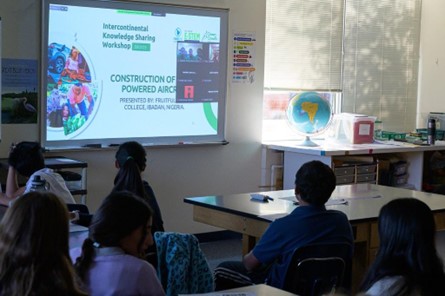
Students at Nysmith School, USA, viewing the presentation by Fruitful Vines College, Nigeria
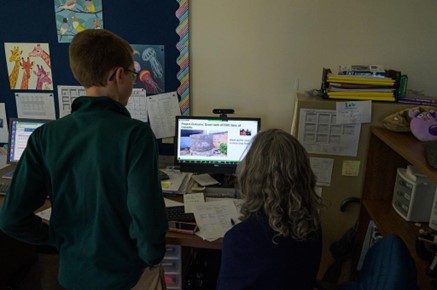
A student from Nysmith School asking questions about the Eco-tank by Etefop TSS School team
The knowledge-sharing was designed to be a two-way process, and as such, middle-school environmental science students representing Nysmith School, USA shared their own learning about the need for urgent action to address climate change. In addition, the students were able to ask questions about each other’s projects, as seen in this clip, which deepened their understanding of how the projects could be replicated.
Overall, the first edition of the International Knowledge Sharing Workshop with Nysmith School, USA was truly incredible. Special thanks to Sheri Sokya, Peter Sokya, and other amazing Nysmith School teachers for making it possible!
Click here to read how the second edition with Climate Youth Japan went!

