
The 2022/2023 Intercontinental Knowledge Sharing Workshop’s finale held on Friday 20th October, 2023 at 11am WAT. The virtual workshop, in collaboration with Climate Youth, Japan also served as a platform for all the student teams within the 2022/2023 EcoHeroes Initiative cohort to share insights on their E-stem projects implementation.
The workshop recorded 69 attendees, of which 57 (27 males, 30 females) were students across 5 secondary schools in Kenya and Nigeria, 9 (5 males, 4 females) teachers, 2 female guests from Japan, 2 male external attendees and 1 expert advisor from Uganda.

Image credit: Intercontinental Knowledge Sharing Workshop, in collaboration with Climate Youth, Japan
At the core of the workshop, each student team had the opportunity to exhibit their E-stem project and define it’s environmental and socioeconomic impacts. The students’ E-stem project includes manufacturing a solar-powered aircraft in line with sustainable aviation and energy efficiency; recycling of waste plastic bags (pure water sachet) into durable plastic school bags for children in rural communities in line with the UN’s call to end plastic pollution; constructing a valorization system for breeding black soldier flies to produce livestock feed and organic fertilizers from food waste in support of the UN’s efforts to address climate change; production of organic fertilizers from plant waste in order to address food insecurity and shortages; and the production of biogas fuel from animal waste in order to eliminate deforestation and promote a just transition to clean and sustainable energy.
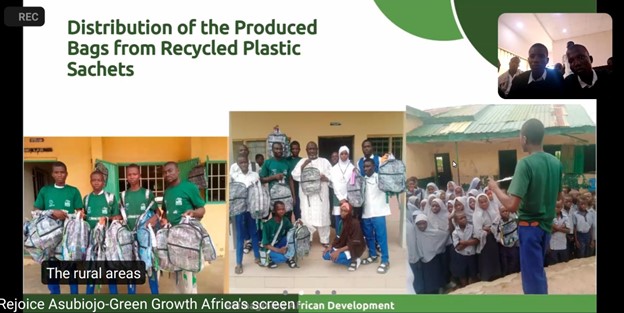
Image credit: Exhibition of the recycled plastic bags by students of AMMK III college of science, Nigeria
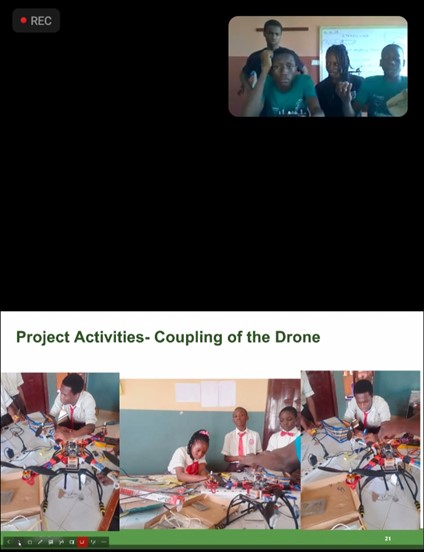
Image credit: Exhibition of the solar-powered aircraft by students of Fruitful Vines College, Nigeria
The workshop also had breakout sessions and the participants were placed in 2 breakout rooms. The focus area and questions asked at the breakout rooms were:
- How is EE implemented in your country?
- What approach is used; learned-centered or teacher-centered?
- How is EE applied; practice oriented or knowledge oriented?
Reacting to these questions, the majority of the student teams from Nigeria highlighted that Environmental Education (EE) was not integrated into the Nigerian educational system. The students further stated that, to the extent that EE is made available to them, it was more teacher-centered and knowledge oriented. However, our guests from CYJ explained that although EE was also not mainstreamed in the Japanese educational systems, however, certain schools across the country may have EE integrated within their school curriculum. She further explained that the approach to EE was dependent on each school. For most international schools, EE could take a more learned-centered outlook whilst in public indigenous schools, EE was more teacher-centered. Notwithstanding, the students in Nigeria and our guests from Japan highlighted that EE is mostly knowledge oriented, however with certain elements of practice. These, therefore, highlights the similarities between the Nigerian and Japanese educational system.
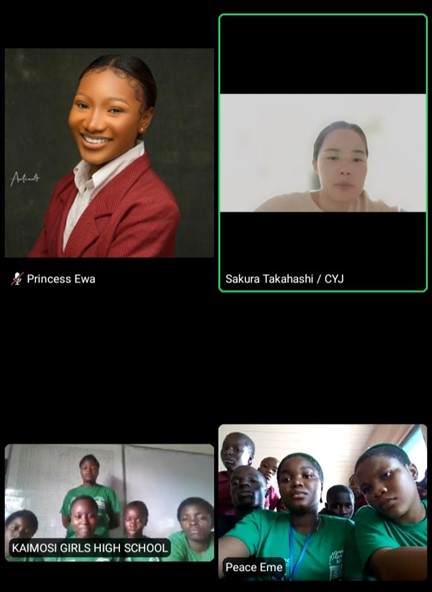
Image credit: Kaimosi Girls High School, Kenya and Imperial Boarding School, Nigeria at the breakout session
On the contrary, the student teams in Kenya highlighted that EE formed a significant part of their educational system, was more practice oriented in their country and commonly learned-centered.
The entire event was Indeed fun, educational and interactive, evident from the students’ remarks:
“We count it a rear privilege to be part of the schools and team participating in this EcoHeroes initiative project. This project has really transformed us, impacted our thought, improved our knowledge and application of basic and theoretical science topics we were taught in class. It has also builds in us a great confidence and boldness to face the future, renewed commitment to community transformation and passion toward social entrepreneurship, all of these is made possible through the support of Green Growth Africa, Pratt and Whitney, and NAAEE. We are grateful and hope to fly high your banner and investment in us”. – Mohammed Jubril (AMMK III College of Science, New Bussa, Nigeria)

